A Practical Checklist for Manufacturing Facility Resilience
Manufacturing leaders are good at evaluating risk. Production, labor, safety, compliance, supply chain all have established processes.
Facility services are different. They rarely generate a dashboard. They rarely trigger an executive review. They tend to get attention only when something breaks down visibly enough to reach leadership. That is exactly where hidden risk can build.
This checklist is designed to help you see whether your current facility services model for manufacturing operations is quietly creating gaps that have not surfaced yet.
1. SAFETY, CLEANING, AND PRODUCTION READINESS
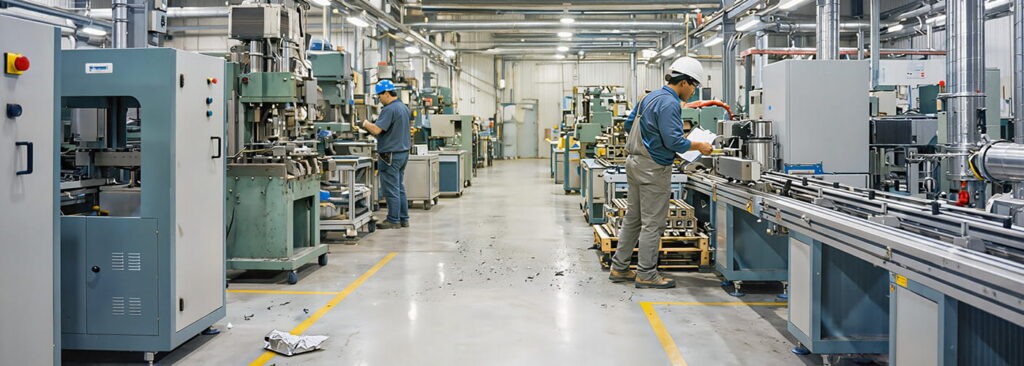
The most common facility safety failure is not a dramatic incident. It is the slow accumulation of small gaps. The spill that sits a little too long. The schedule that does not account for a shift change. The recurring complaint that gets noted but not corrected. None of these feel like an urgent situation until it suddenly is.
Questions to consider:
- Are spills, debris, residue, and slip risks addressed quickly and consistently?
- Are cleaning standards clearly defined by area, use, traffic level, and operational risk?
- Are production-adjacent spaces treated differently than offices, restrooms, breakrooms, or common areas?
- Are high-touch, high-traffic, and high-visibility areas inspected regularly?
- Are cleaning schedules aligned with shift changes, production activity, and site traffic?
- Are missed tasks, recurring hazards, and repeated complaints documented, reviewed, and corrected?
- Is there a clear process for urgent response when safety or cleanliness issues arise?
Potential gaps:
Watch for recurring complaints, slow response to spills or hazards, cleanliness that varies by shift or building, and cleaning schedules that do not match actual facility use. A facility may look covered on paper while still creating risk if safety-sensitive cleaning needs are handled reactively instead of proactively.
2. STAFFING, TRAINING, AND SUPERVISION
When staffing is unstable, even the strongest scope of work starts to break down. Tasks get skipped. New workers perform inconsistently. Supervisors are spread too thin to catch it. And your internal teams quietly start filling the gaps, without anyone formally acknowledging that the model is not working.
Questions to consider:
- Is staffing coverage strong enough to support the full scope of work?
- Are backup plans in place for absences, turnover, or schedule changes?
- Are supervisors visible, engaged, and accountable for follow-through?
- Are new employees trained before they are expected to perform independently?
- Are teams familiar with the pace, safety expectations, and operational sensitivity of the manufacturing environment?
- Are labor gaps creating extra work for internal teams?
- Is turnover affecting service consistency across shifts, buildings, or zones?
Potential gaps:
Watch for frequent missed tasks tied to labor shortages, new workers who are unfamiliar with site expectations, inconsistent supervision, or internal teams stepping in to manage vendor and coverage issues. A resilient facility services model should reduce staffing uncertainty, not shift it onto plant, operations, or facilities leaders.
3. SPECIALTY SERVICES AND URGENT RESPONSE

Manufacturing facilities often need more than routine cleaning. Floor care, deep cleaning, high dusting, pressure washing, post-project cleaning, emergency response, and other industrial cleaning and specialty services may need to be handled around production schedules, safety requirements, and operational priorities.
Questions to consider:
- Are specialty service needs planned in advance when possible?
- Is there a process for urgent or unexpected specialty requests?
- Can work be scheduled around production demands, downtime windows, and safety requirements?
- Are specialty teams trained and equipped for the environment?
- Are scopes, timelines, and expectations clearly communicated before work begins?
- Are completed projects reviewed for quality and follow-through?
- Are specialty service needs being delayed because no one clearly owns them?
Potential gaps:
Watch for deferred projects that keep getting pushed back, specialty work that disrupts production activity, slow responses when urgent needs arise, or lack of clarity around who owns non-routine work. The work that falls outside the daily routine is often the work that creates the most visible disruption when it is not handled well.
4. COMPLIANCE-SENSITIVE AREAS
Some manufacturing environments carry higher compliance expectations. Life sciences, biopharma, aerospace, food-adjacent, medical manufacturing, and other regulated environments may require specific cleaning processes, documentation, training, quality checks, and escalation procedures.
Questions to consider:
- Are compliance-sensitive areas clearly identified?
- Are cleaning and maintenance processes documented where needed?
- Are employees trained on area-specific protocols?
- Are inspections and quality checks recorded consistently?
- Are vendors aware of the operational and compliance sensitivity of the environment?
- Are process changes communicated clearly?
- Are documentation gaps reviewed before they become audit concerns?
Potential gaps:
Watch for inconsistent process documentation, workers being uncertain which areas require special handling, procedures that are too generic for facility conditions, or poor handoffs between shifts, supervisors, and vendors. In compliance-sensitive environments, consistency is not optional. It is part of maintaining confidence in the facility.
5. EXTERIOR AND SITEWIDE RISK POINTS

The facility does not stop at the production floor. Parking lots, sidewalks, loading docks, entrances, landscaping, drainage areas, exterior lighting, waste areas, and access roads all affect safety, appearance, movement, and operational readiness.
Questions to consider:
- Are exterior areas inspected regularly?
- Are entrances, sidewalks, docks, access roads, and other access points kept clear and safe?
- Are drainage, standing water, overgrowth, weather-related hazards, and trip risks addressed proactively?
- Are exterior cleaning and pressure washing needs identified before they become visible problems?
- Are seasonal risks built into the service plan?
- Are landscaping and grounds services aligned with safety, access, and curb appeal?
- Is there a clear owner for exterior issue response?
Potential gaps:
Watch for exterior issues that are addressed only after complaints, overlooked loading areas or back-of-house spaces, poor coordination between services vendors, or safety risks created by weather, drainage, or neglected access points. Exterior conditions influence employee safety, visitor perception, vendor access, and daily operations. They should be managed as part of the full facility environment.
6. SUSTAINABILITY EXECUTION
Sustainability goals often depend on what happens at the facility level. Waste management, recycling, material handling, green cleaning, equipment choices, water use, energy-related maintenance, and reporting practices can all support or weaken progress toward broader sustainability commitments.
Questions to consider:
- Are sustainability goals translated into facility-level actions?
- Are cleaning products, equipment, and processes aligned with internal standards?
- Are recycling and waste streams clearly managed?
- Are teams trained on sustainability-related procedures?
- Are results tracked and communicated?
- Are sustainability expectations included in vendor scopes?
- Are cost, compliance, and sustainability being considered together?
Potential gaps:
Watch for sustainability goals that are not reflected in daily service practices, unclear waste or recycling processes, green cleaning claims lacking clear standards or follow-through, limited reporting, or facility teams left out of broader planning. Sustainability is not just a corporate initiative, it is an operational practice.
7. VISIBILITY, ACCOUNTABILITY, AND VENDOR FIT
Most facility services problems do not appear all at once. They build quietly when reporting structures, inspections, escalation paths, and vendor expectations do not make them easy to see.
Manufacturing leaders need visibility into whether the facility services model is actually working. Without reporting, accountability, and clear vendor expectations, service issues can become difficult to evaluate until something goes wrong. Many challenges also begin before the contract is signed, when scopes are too generic or vendor evaluation focuses too heavily on price and task completion.
Questions to consider:
- Is service performance measured consistently?
- Are inspections documented and reviewed?
- Are issues tracked through resolution?
- Are recurring problems identified and addressed?
- Are communication routines clear between facility teams, operations, and vendors?
- Are supervisors and vendors accountable for follow-through?
- Do scopes and RFPs define expectations by area, risk level, operating schedule, staffing, training, reporting, and urgent response?
- Does vendor evaluation consider manufacturing experience, regulated-environment experience, long-term value, and risk reduction instead of lowest cost alone?
Potential gaps:
Watch for a lack of consistent inspection processes, repeated issues without root-cause review, reports that summarize activity without identifying trends or corrective measures, unclear escalation paths, or vendor selection heavily weighted on cost. A resilient facility services model should make performance easier to see, not harder to prove.
What Your Answers May Reveal
If you answered “no” or “not sure” to several of the above questions, your facility services model may be creating more risk than it appears.
That does not always mean the model is broken. It may mean responsibilities need to be clearer, staffing needs more structure, reporting needs to improve, specialty services need a more proactive plan, exterior risk points need more attention, or vendor expectations need better alignment with the realities of the manufacturing environment.
The most important question is not simply whether the work is getting done. It is whether the current model is reducing risk, improving accountability, and helping the facility stay prepared for what comes next.
Is Your Facility Services Model Reducing Risk — Or Creating It?
Manufacturing resilience depends on many factors: equipment, people, processes, supply chains, and leadership. But it also depends on the facility environment that supports daily operations.
When cleaning, maintenance, staffing, exterior care, specialty response, compliance support, sustainability practices, reporting, and vendor accountability are managed well, they help reduce uncertainty and give internal teams more confidence.
The Budd Group works with manufacturing and industrial facilities to build cleaner, safer, more accountable facility services programs around the realities of daily operations. Whether the need is restructuring a current program, filling specific gaps, or building a more reliable vendor model, our starting point is the same: identifying where risk is forming and what a more resilient approach should look like.